Why this matters in two-storey homes
In a single-storey house, a failed shower membrane usually shows up as damp in the wall or rot in the frame. In a two-storey Hills home the bathroom is often above the kitchen, family room or entry, and the first sign is a brown ring on that ceiling. By then the floor sheeting under the shower is often damaged too.
A proper membrane, installed and cured correctly, is what prevents that.
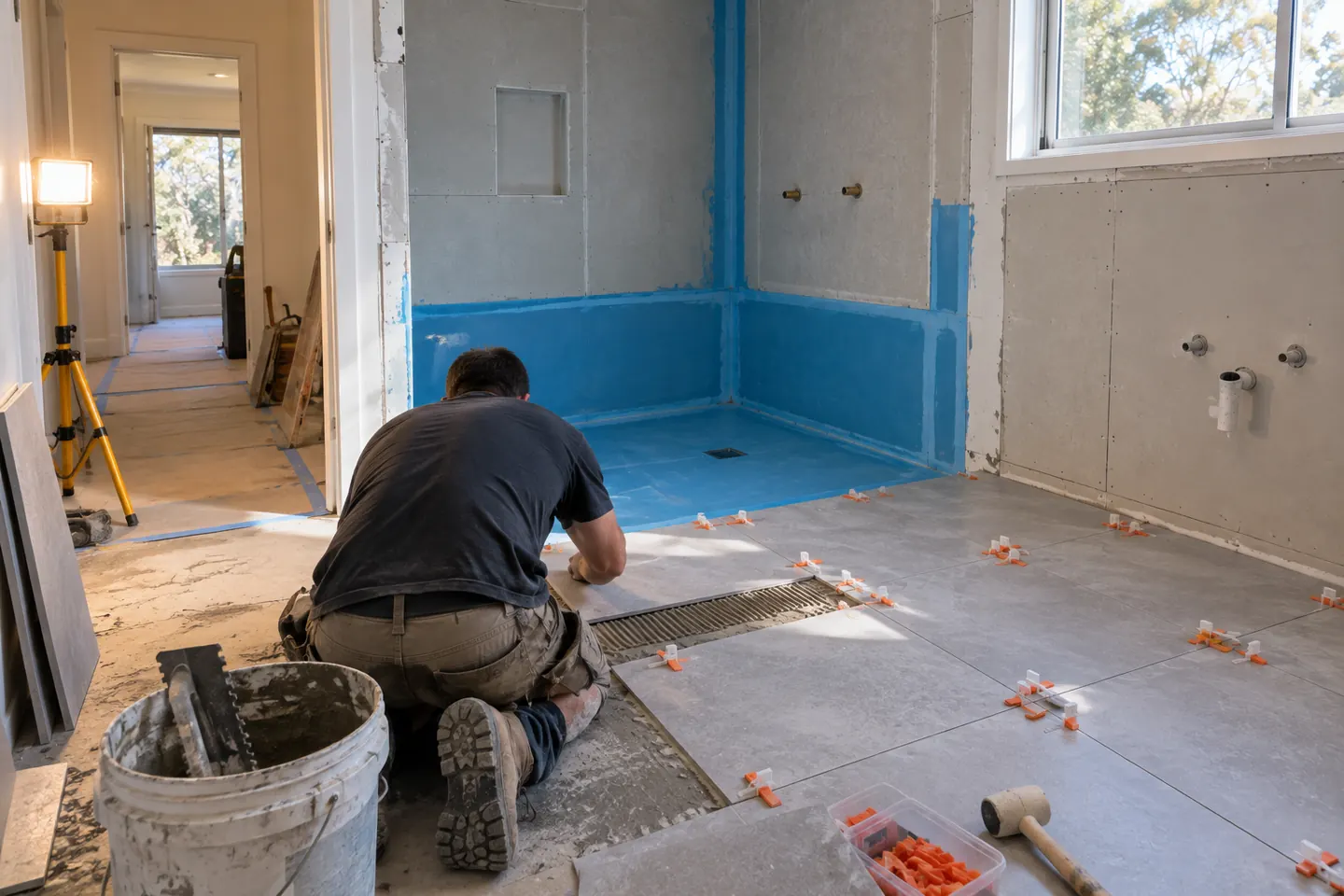
The waterproofing stage
- Substrate prepared. Wet-area sheeting fixed, joints and corners sealed, floor sheeting checked and replaced if water-affected.
- Primer applied to suit the membrane system.
- Bond breakers and reinforcing at wall-floor junctions and corners, so building movement does not tear the membrane.
- Puddle flanges at the floor wastes.
- Membrane coats applied to the required thickness, extending up the walls and across the floor to the specified heights and areas.
- Cure time respected before screeding or tiling.
- Certificate issued by the licensed waterproofer.
Tiling that finishes the job
Screed with the right fall. Floors graded toward a linear or centre drain so water never ponds at the glass.
A planned set-out. Tiles laid out on paper first so full tiles land at the doorway and around the niche, and cuts sit in corners you do not look at.
Large-format care. Big porcelain tiles need flat walls, the right adhesive coverage and levelling clips.
Movement joints. Flexible sealant at internal corners and changes of plane, not rigid grout that cracks.
Waterproof grout lines are not the goal. Grout controls appearance and cleaning. The membrane does the waterproofing.
Common problems we find in older Hills bathrooms
- Mortar-bed showers with no membrane, typical of some older homes.
- Membranes that stop short of the wall height needed around the shower.
- Shower bases and hobs that have separated from the wall.
- Particleboard floors swollen where water has leaked through.
- Grout repaired so many times it now traps moisture behind it.
Asbestos before demolition
In homes built or renovated before about 1990, older wet-area wall sheeting may contain asbestos. A sample is tested before any demolition, and removal is carried out by a licensed asbestos removalist.
Part of every renovation
Waterproofing and tiling is included in every bathroom, ensuite and laundry renovation we price. Where a single shower has failed and the rest of the room is sound, a shower-only rebuild may be an option after inspection.
See how we renovate for where this stage sits in the program.
Call 02 4404 2242 or send us the room details.
Related upgrades
| Bathroom Renovations | The upstairs family bathroom stripped to the frame and rebuilt — new set-out, membrane, tiles and fittings, priced as one job. |
|---|---|
| Ensuite Renovations | Master ensuites from the 1980s and 90s reworked for two adults on the same morning timetable. |
| Small Bathrooms & Powder Rooms | Downstairs powder rooms, guest toilets and compact second bathrooms that take a beating from a busy household. |
| Accessible Bathrooms | Level-entry showers, reinforced walls for rails and safer floors, so a two-storey family home still works for the long term. |
| Laundry Renovations | Laundries with real bench space, hidden hampers and a proper place for sports gear, done with the bathroom or on their own. |
Questions people ask before they commit
Who can do waterproofing in NSW?
Waterproofing is specialist work in NSW and must be done by a person holding the appropriate licence. The work should follow the relevant Australian Standard for domestic wet areas, and a certificate should be provided at completion.
How long does the membrane need to cure?
It depends on the product, the number of coats and the temperature and humidity. Liquid membranes commonly need a day or more between coats and before tiling, and colder Hills winter days slow that down. The manufacturer's instructions set the minimum.
Can you waterproof over existing tiles?
Not as a lasting fix for a failed shower. Some products are sold for tiling over tiles, but if water has already got past the old membrane the substrate underneath needs to be inspected and repaired, which means removing the tiles.
What is a fall to waste?
The slope in the floor that directs water to the drain. It is created in the screed under the tiles. Too little fall leaves puddles, too much makes the floor feel uneven, and the correct fall is set before tiling begins.